F5 F5CAB5 Testdump, F5CAB5 Latest Mock Test
Wiki Article
DOWNLOAD the newest 2Pass4sure F5CAB5 copyright from Cloud Storage for free: https://drive.google.com/open?id=1CSHDbJ505cISgbQyMxFxHfm9S5IUM6wN
Our BIG-IP Administration Support and Troubleshooting test torrent was designed by a lot of experts in different area. You will never worry about the quality and pass rate of our study materials, it has been helped thousands of candidates pass their exam successful and helped them find a good job. If you choose our F5CAB5 study torrent, we can promise that you will not miss any focus about your exam. There are three different versions to meet customers’ needs you can choose the version that is suitable for you to study. If you buy our BIG-IP Administration Support and Troubleshooting test torrent, you will have the opportunity to make good use of your scattered time to learn whether you are at home, in the company, at school, or at a metro station.
You can hardly grow by relying on your own closed doors. Our F5CAB5 preparation materials are very willing to accompany you through this difficult journey. You know, choosing a good product can save you a lot of time. And choose our F5CAB5 exam questions will save more for our F5CAB5 learning guide is carefully compiled by the professional experts who have been in this career for over ten years. So our F5CAB5 practice copyright contain all the information you need.
F5 - F5CAB5 - BIG-IP Administration Support and Troubleshooting –Efficient Testdump
Three versions of F5CAB5 exam dumps are provided by us. Each version has its own advantages. F5CAB5 PDF version is printable and you can take it with you. F5CAB5 Soft test engine can stimulate the real exam environment, so that it can release your nerves while facing the real exam. F5CAB5 Online Test engine can be used in any web browsers, and it can also record your performance and practicing history. You can continue your practice next time.
F5 F5CAB5 Exam Syllabus Topics:
| Topic | Details |
|---|---|
| Topic 1 |
|
| Topic 2 |
|
| Topic 3 |
|
| Topic 4 |
|
| Topic 5 |
|
| Topic 6 |
|
F5 BIG-IP Administration Support and Troubleshooting Sample Questions (Q14-Q19):
NEW QUESTION # 14
A BIG-IP Administrator configured the following virtual server to pass traffic on all addresses and ports.
After configuration is completed, the BIG-IP Administrator notices that the virtual server is unable to pass traffic.
ltm virtual forwarding_any_vs {
destination 0.0.0.0:any
ip-forward
mask 255.255.255.255
profiles {
fastL4 { }
}
serverssl-use-sni disabled
source 0.0.0.0/0
translate-address disabled
translate-port disabled
}
Which part of the configuration is the cause of the issue? (Choose one answer)
- A. Incorrect mask 255.255.255.255
- B. Incorrect destination configured
- C. Incorrect translate-address configured
Answer: A
Explanation:
This virtual server is intended to function as aforwarding (IP-forwarding) virtual server, which is commonly used for routing or firewall-style deployments where BIG-IP forwards traffic transparently without load balancing or address translation. For a forwarding virtual server to match and passall traffic, the destination must be configured as 0.0.0.0:anywith a mask of 0.0.0.0, not 255.255.255.255.
The configured mask 255.255.255.255 represents a/32 host mask, which restricts the virtual server to matching traffic destined only for the exact IP address 0.0.0.0. Since 0.0.0.0 is not a valid routable destination for normal traffic, no packets will ever match the virtual server, causing it to pass no traffic at all.
This is a well-documented BIG-IP behavior:
* destination 0.0.0.0:any
* mask 0.0.0.0
together define acatch-all forwarding virtual server.
The destination itself (Option A) is correct for a forwarding VS, and disabling address translation (Option C) is expected and required for IP-forwarding mode. Therefore, the incorrect subnet mask is the sole reason the virtual server is not functioning as expected.
NEW QUESTION # 15
Clients report that they cannot reach the virtual server vs-production on port 80, but are able to ping the virtual server address. The configuration is shown below:
Plaintext
ltm virtual vs-production {
destination 10.99.20.50:http
ip-protocol tcp
mask 255.255.255.255
profiles {
http {}
tcp {}
}
source 192.168.0.0/16
translate-address enabled
translate-port enabled
vlans {
external
}
vlans-enabled
}
What is the cause?
- A. The virtual server does NOT listen on port 80.
- B. The client uses an old browser.
- C. The virtual server is disabled.
- D. The client comes from an unallowed subnet.
Answer: D
Explanation:
The issue is caused by the Source Address restriction configured on the virtual server.
* Source Filter: The configuration contains the line source 192.168.0.0/16. This acts as an implicit Access Control List (ACL). The virtual server will only accept and process TCP connections if the client's source IP address falls within the 192.168.x.x range.
* Why Ping Works: ICMP (Ping) is handled by the Virtual Address object, not the Virtual Server object. Unless ICMP is specifically disabled on the Virtual Address, it will respond to pings from any subnet, even if the Virtual Server itself is restricted by a source filter or is even disabled.
* Evaluation of Other Options:
* Disabled (Option A): If the VS were disabled, the configuration would typically show disabled or state down, and the symptoms would be similar, but the source filter is a more specific
"misconfiguration" in this context.
* Port 80 (Option C): The configuration destination 10.99.20.50:http explicitly confirms it is listening on port 80.
* Unallowed Subnet: If a client from a different network (e.g., 10.10.1.5) tries to connect, the BIG- IP will silently drop the connection or send a reset because it does not match the defined source criteria.
NEW QUESTION # 16
A BIG-IP Administrator creates a new Virtual Server. The end user is unable to access the page.
During troubleshooting, the administrator learns that the connection between the BIG-IP system and server is NOT set up correctly. What should the administrator do to solve this issue?
- A. Set Address Translation to SNAT and configure a specific translation address
- B. Disable Address Translation
- C. Set Address Translation to Auto Map, configure a SNAT pool, and have pool members in the same subnet of the servers
- D. Set Address Translation to SNAT and have self-IP configured in the same subnet of servers
Answer: A
Explanation:
When a virtual server is not working as expected despite the pool members being marked "UP" (Green), the issue is frequently a return-path routing failure. If the BIG-IP forwards a request with the original client's source IP address, the backend server will try to respond directly to that client.
If the server does not have its default gateway pointed back to the BIG-IP, the response packet will be routed elsewhere (or dropped), resulting in a connection timeout for the user. To resolve this, the administrator must configure "Source Address Translation" (SNAT). By setting SNAT to
"Automap" or a specific SNAT address, the BIG-IP replaces the client's IP with its own internal self-IP. The backend server then sees the BIG-IP as the source and sends the response back to it locally. This troubleshooting step ensures a functional, symmetric traffic flow. Identifying the need for SNAT is one of the most common troubleshooting tasks for new virtual server deployments where the BIG-IP is not the default gateway for the backend servers.
NEW QUESTION # 17
Refer to the exhibit.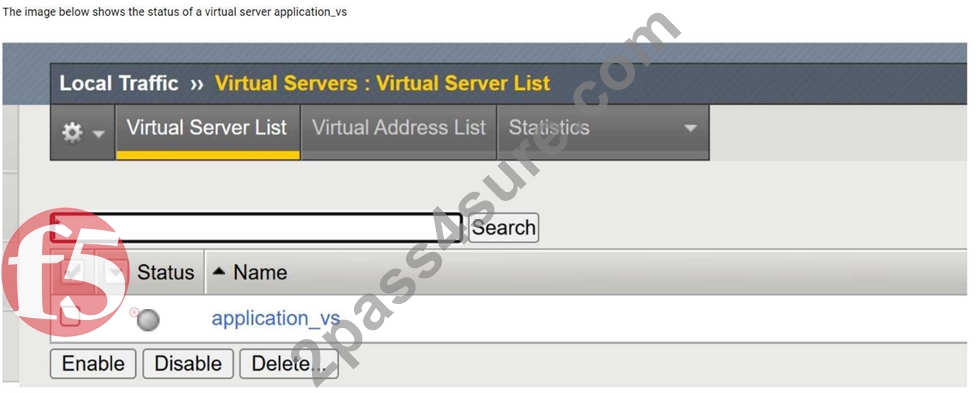
The image shows the status of a virtual server namedapplication_vsin the BIG-IP Configuration Utility.
What is the cause of the status shown? (Choose two answers)
- A. Pool member(s) administratively disabled
- B. Pool member(s) forced offline
- C. Virtual Server administratively disabled
- D. Node(s) administratively disabled
Answer: A,D
Explanation:
The exhibit shows the virtual serverapplication_vswith a status indicating it isoffline but enabled. In BIG-IP terminology, this status means the virtual server itself is administratively enabled, but it is unable to pass traffic becauseno usable pool members are available.
Two common and documented causes for this condition are:
Pool member(s) administratively disabled (Option A):When all pool members are administratively disabled, BIG-IP removes them from load-balancing decisions. Even though the virtual server remains enabled, it has no available pool members to send traffic to, resulting in an offline status.
Node(s) administratively disabled (Option C):Pool members inherit the status of their parent nodes. If a node is administratively disabled, all associated pool members are also marked unavailable. This condition causes the virtual server to show as offline, even though the virtual server configuration itself is correct.
The other options are incorrect:
Forced offline pool members (Option B)result in a different operational intent and are explicitly set for maintenance scenarios.
Virtual server administratively disabled (Option D)would show the virtual server as disabled, not enabled/offline.
This behavior is consistent with BIG-IP traffic management logic and is commonly verified by reviewingpool and node availability stateswhen diagnosing virtual server availability issues.
NEW QUESTION # 18
Which menu should you use on the BIG-IP Configuration Utility to generate a QKView support file? (Choose one answer)
- A. System > Configuration
- B. System > Support
- C. System > Logs
- D. System > Archive
Answer: B
Explanation:
Comprehensive and Detailed 150 to 250 Words Explanation From BIG-IP Administration, Support, and Troubleshooting Documents:
A QKView file is the primary diagnostic support bundle used by F5 Support to troubleshoot BIG-IP system issues. It contains comprehensive system information, including running configuration, licensing details, module provisioning, hardware status, software versions, log files, statistics, and the output of numerous diagnostic commands. Generating a QKView is a standard and recommended first step when investigating performance problems, configuration issues, or when opening a support case with F5.
In the BIG-IP Configuration Utility (GUI), the correct and supported location to generate a QKView is System > Support. This menu is specifically designed for support and troubleshooting operations. From this section, administrators can generate a QKView file, monitor its creation progress, download it locally, or upload it directly to F5 iHealth for automated analysis. This workflow is clearly documented in BIG-IP Administration and Support guides and aligns with F5 best practices.
The other menu options are not appropriate:
System > Configuration is used for system-wide settings such as DNS, NTP, and device identity.
System > Archive is used to create UCS backup files, which are configuration backups, not diagnostic bundles.
System > Logs is used only for viewing system logs, not generating support files.
Therefore, System > Support is the correct and only valid answer.
NEW QUESTION # 19
......
Everyone wants to succeed. As a worker in IT industry, you know how important the F5CAB5 exam certification is for your career success. There are more and more people to participate in F5CAB5 certification exam, and how to win in the increasingly competitive situation? To chose the right hand is the key. Our 2Pass4sure team has studies the F5CAB5 Certification Exam for years so that we have in-depth knowledge of the test. We believe that you must be succeed in the exam with the help of F5CAB5 test software provided by our 2Pass4sure.
F5CAB5 Latest Mock Test: https://www.2pass4sure.com/F5-CA/F5CAB5-actual-exam-copyright.html
- F5CAB5 Valid Practice Materials ???? Exam F5CAB5 Reference ???? F5CAB5 Free copyright ???? Immediately open ⮆ www.prepawayete.com ⮄ and search for ➥ F5CAB5 ???? to obtain a free download ????Valid F5CAB5 Test Simulator
- Exam F5CAB5 Vce Format ???? Demo F5CAB5 Test ???? Exam F5CAB5 Reference ???? Search for [ F5CAB5 ] and easily obtain a free download on 《 www.pdfvce.com 》 ????F5CAB5 Free copyright
- Exam Questions F5CAB5 Vce ???? F5CAB5 Latest copyright Free ???? Reliable F5CAB5 Test Objectives ???? Search for ✔ F5CAB5 ️✔️ and download it for free immediately on ▛ www.prep4sures.top ▟ ????Valid F5CAB5 Test Simulator
- F5 F5CAB5 Questions To Complete Your Preparation ???? The page for free download of ☀ F5CAB5 ️☀️ on { www.pdfvce.com } will open immediately ????Exam F5CAB5 Vce Format
- F5 F5CAB5 Testdump: BIG-IP Administration Support and Troubleshooting - www.troytecdumps.com Try Free and Buy Easily ???? Search for ➥ F5CAB5 ???? and download it for free on ⇛ www.troytecdumps.com ⇚ website ????Exam F5CAB5 Reference
- Download Updated F5 F5CAB5 Exam Question and Start Preparation Today ⏭ Easily obtain [ F5CAB5 ] for free download through ➤ www.pdfvce.com ⮘ ????Customizable F5CAB5 Exam Mode
- F5CAB5 Sure-Pass Torrent: BIG-IP Administration Support and Troubleshooting - F5CAB5 Test Torrent - F5CAB5 Exam Guide ???? Search on ➤ www.practicevce.com ⮘ for ✔ F5CAB5 ️✔️ to obtain exam materials for free download ⛅Valid F5CAB5 Test Simulator
- F5CAB5 Testdump | Reliable F5CAB5: BIG-IP Administration Support and Troubleshooting ???? Download ▛ F5CAB5 ▟ for free by simply searching on ▷ www.pdfvce.com ◁ ⛳New F5CAB5 Exam Vce
- F5 F5CAB5 Questions To Complete Your Preparation ???? Open website 【 www.examcollectionpass.com 】 and search for ⏩ F5CAB5 ⏪ for free download ????F5CAB5 Test Testking
- Valid F5CAB5 Test Simulator ???? Exam F5CAB5 Vce Format ???? F5CAB5 Pdf Torrent ???? Download ⮆ F5CAB5 ⮄ for free by simply entering “ www.pdfvce.com ” website ????Valid Dumps F5CAB5 Sheet
- Outstanding F5CAB5 Exam Brain Dumps: BIG-IP Administration Support and Troubleshooting supply you high-quality Practice Materials - www.vceengine.com ???? Search for ⮆ F5CAB5 ⮄ on “ www.vceengine.com ” immediately to obtain a free download ????Exam F5CAB5 Reference
- myportal.utt.edu.tt, myportal.utt.edu.tt, myportal.utt.edu.tt, myportal.utt.edu.tt, myportal.utt.edu.tt, myportal.utt.edu.tt, myportal.utt.edu.tt, myportal.utt.edu.tt, myportal.utt.edu.tt, myportal.utt.edu.tt, social-galaxy.com, honeytvhz501524.losblogos.com, www.stes.tyc.edu.tw, www.stes.tyc.edu.tw, siobhantssj390960.answerblogs.com, gratis-directory.com, ronaldqloe872303.blogchaat.com, poppysvac195446.snack-blog.com, blakeklfc935678.smblogsites.com, Disposable vapes
BTW, DOWNLOAD part of 2Pass4sure F5CAB5 dumps from Cloud Storage: https://drive.google.com/open?id=1CSHDbJ505cISgbQyMxFxHfm9S5IUM6wN
Report this wiki page